
For an Indian MSME, growth rarely fails because of weak demand. It stalls because the way the business wins customers does not scale. Founder-led selling, a few loyal referrals, and opportunistic orders can carry a firm to a point — and then acquisition costs climb, effort scatters, and revenue becomes unpredictable. The fix is not more hustle. It is a deliberate, repeatable go-to-market (GTM) system. This guide lays out what that system looks like for an MSME, and four practical moves to build it.
India’s MSME sector is both vast and rapidly digitising. It accounts for roughly 31% of GDP and close to half of the country’s exports, with around 7.86 crore enterprises now registered. Just as importantly, about 72% of MSME transactions are already digital, and new rails like UPI and the ONDC network are lowering the cost of reaching customers. The businesses that turn this digital shift into a structured go-to-market model are the ones pulling ahead.
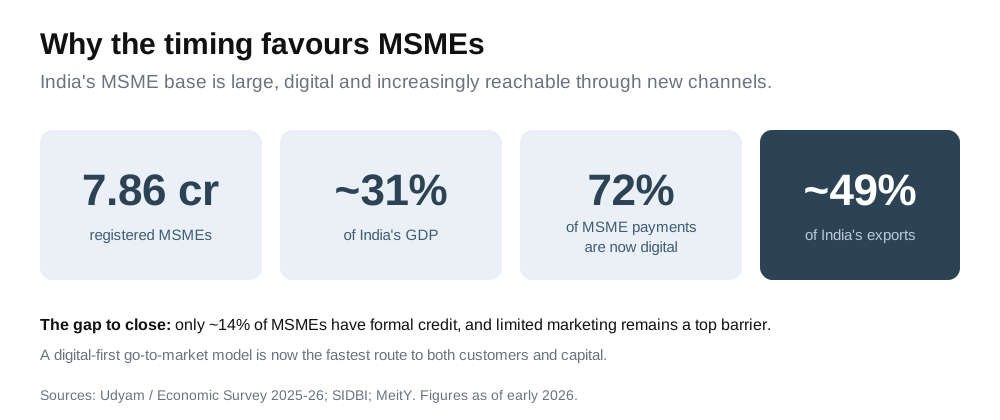
The flip side is the gap. Only around 14% of MSMEs have access to formal credit, and limited marketing capability is repeatedly cited as a top barrier to growth. A strong go-to-market model addresses both at once: it wins customers predictably, and the digital footprint it creates — sales data, GST records, transaction history — is increasingly what unlocks working capital.
A scalable go-to-market strategy is a system for consistently turning strangers into customers and customers into growth — one that keeps working as you add products, segments and regions. It treats marketing, sales and customer success as a single revenue engine rather than separate activities. For an MSME, the goal is not to copy a large enterprise’s playbook, but to build a lean version that is repeatable, measurable and expansion-ready. Four moves make that possible.
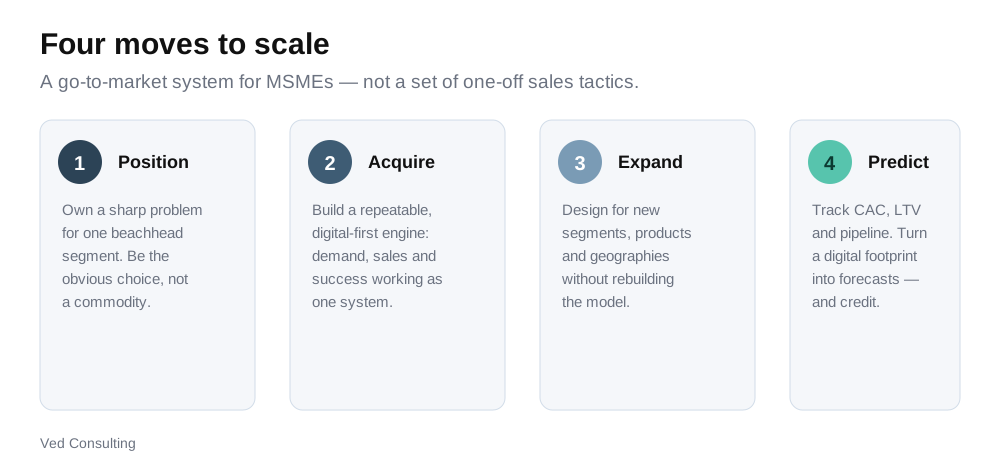
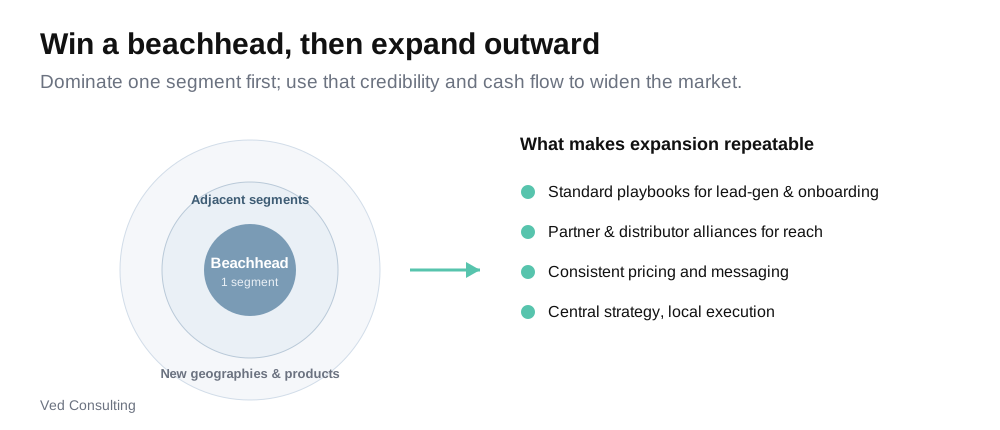
Most firms start with “where do we sell?” — ads, a sales team, a marketplace. Scalable growth starts one step earlier, with sharp positioning. In crowded markets, buyers choose the business that most clearly solves their specific problem; without differentiation, even a good product becomes a commodity that competes only on price. Pick one high-value beachhead segment, define the problem you solve better than anyone else, and make sure your pricing, product and messaging all say the same thing. Winning one segment convincingly creates the credibility and cash flow that fund everything after it.
Early customers arrive through hustle. Sustainable customers arrive through a repeatable engine where demand generation, sales and customer success work as one loop. Demand creates a pipeline — increasingly through digital channels, ONDC and referrals rather than cold outreach alone. Sales qualifies and converts it. Customer success retains buyers and grows their value, which in turn feeds fresh demand through referrals and repeat business. For an MSME, this integration is what stops acquisition costs from spiralling as you grow.
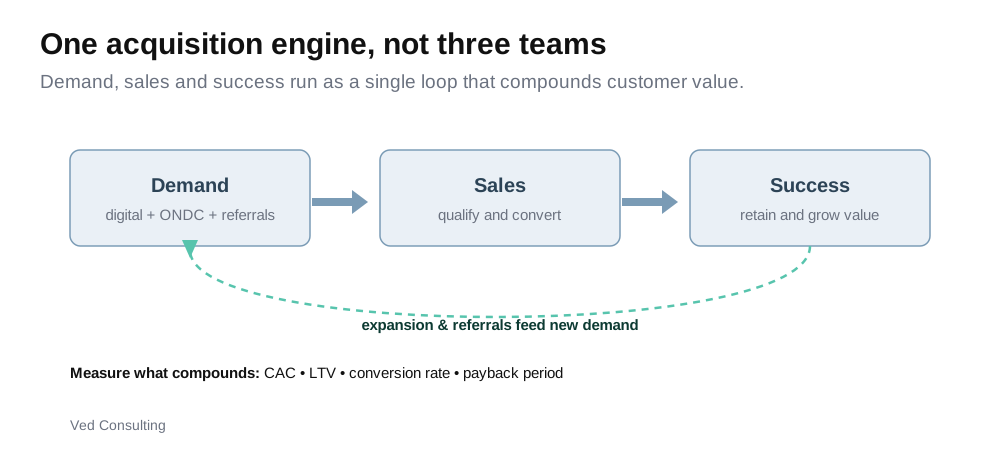
Whatever channels you use, measure the economics: customer acquisition cost (CAC), lifetime value (LTV), conversion rate and payback period. These four numbers tell you whether growth is healthy or just expensive.
Many MSME go-to-market approaches are built for initial traction, not for scale — so every new segment or region means rebuilding the commercial model from scratch. A better approach: win the beachhead, then expand outward into adjacent segments and, later, new geographies and products. Expansion becomes repeatable when you standardise the core playbooks (lead generation, qualification, onboarding), lean on partner and distributor alliances for reach, keep pricing and messaging consistent, and run a central strategy that regional teams adapt locally.
Scaling is as much an organisational shift as a sales one. Founder-driven selling has to evolve into a structured system with clear ownership across marketing, sales and success, and simple data discipline: a basic CRM, tracked pipeline, and regular review. Predictable revenue lets an MSME allocate resources with confidence and invest ahead of demand. It also compounds: the same digital and transaction data that makes forecasting possible is exactly what flow-based lenders, account-aggregator platforms and banks now use to extend credit — turning a disciplined GTM system into better access to capital.
| Dimension | Early-stage selling | Scalable GTM system |
|---|---|---|
| Source of growth | Founder effort and referrals | A repeatable acquisition engine |
| Focus | Any customer who says yes | One sharp beachhead segment |
| Teams | Marketing, sales, service siloed | One integrated revenue loop |
| Measurement | Revenue only | CAC, LTV, conversion, payback |
| Expansion | Rebuilt each time | Standard playbooks and partners |
| Credit access | Informal, relationship-based | Data-backed and formal |
The usual failure modes are avoidable. Chasing every segment at once dilutes positioning and burns cash. Adding channels before the economics work simply scales a loss. Leaving marketing, sales and service disconnected produces an inconsistent pipeline. And treating GTM as a one-off campaign rather than a standing capability means the system never compounds. Start lean, prove the unit economics on one segment, then widen.
For India’s MSMEs, the market opportunity has rarely been more accessible — a huge, digitising customer base reachable through new low-cost channels. But opportunity rewards structure. The firms that grow durably are the ones that position sharply, build a repeatable acquisition engine, design for expansion, and run on predictable, data-backed revenue. Get those four moves right, and growth stops being a matter of chance and becomes a capability you own.
Posted by the Research Team at Ved Consulting. Ved Consulting helps Indian MSMEs design scalable go-to-market strategies and modern growth systems.
Connect with us on LinkedIn: https://www.linkedin.com/company/vedconsulting/