It is the question quietly sitting under every conversation about artificial intelligence: will it take my job? The honest answer is neither the reassuring “no, AI only creates jobs” nor the alarmist “yes, we are all finished.” Both are comfortable in their certainty and wrong in their simplicity. The truthful answer is more useful and more demanding: it depends — on your role, your skills, and how you respond. This is a rational, forward-looking attempt to replace anxiety with clarity, starting from what the data actually shows.
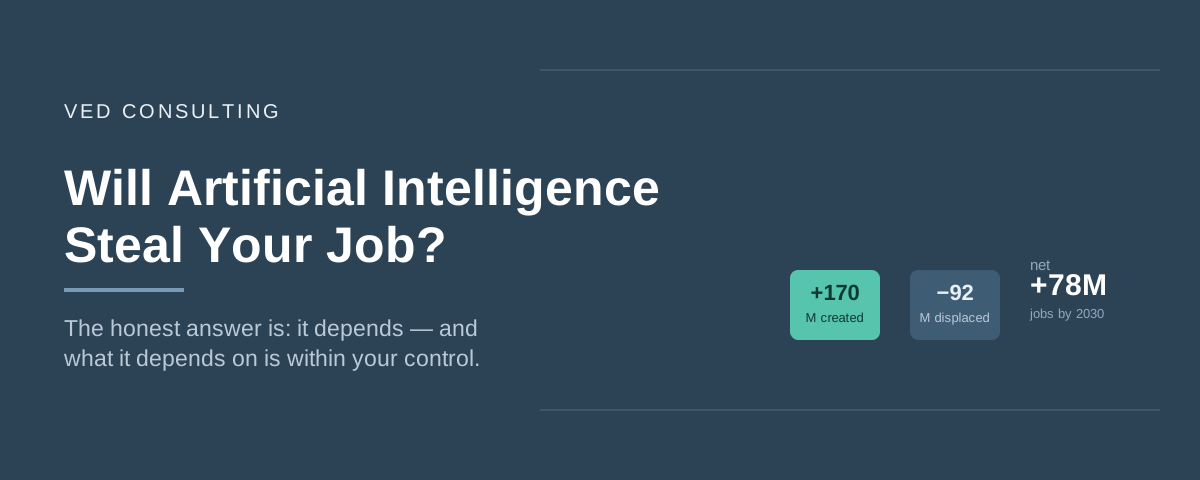
The most credible large-scale estimates, from the World Economic Forum’s work on the future of jobs, point to a striking dual movement. By 2030, AI and related technologies are projected to create roughly 170 million new roles globally while displacing around 92 million existing ones — a net increase of about 78 million jobs, equivalent to roughly 22% structural churn in the formal-jobs base. Alongside this, around 86% of businesses expect AI to transform how they operate by 2030, and about 39% of the skills workers hold today are expected to become outdated over the same period. Meanwhile, an estimated 120 million workers globally face a meaningful risk that their current roles will be significantly automated within three to five years.
Read carelessly, these numbers offer reassurance: a net gain of 78 million jobs. Read carefully, they contain a warning. Net creation coexists with massive displacement, a large-scale rewriting of required skills, and real, near-term redundancy risk for tens of millions. Both things are true at once. Rational planning means holding both.
The single most useful distinction in this debate is between automation and augmentation. Automation is AI doing a task instead of a person. Augmentation is AI doing part of a task so a person can do the rest better and faster. The evidence from how AI is actually being used in real workplaces shows a shifting mix of both — not a wholesale replacement of jobs, but a reshaping of tasks within them.
This matters because most jobs are bundles of many tasks, and AI rarely automates all of them. It automates the routine, repetitive, and predictable components while leaving — and often amplifying — the parts that require judgment, creativity, and human relationship. For most people, the realistic near-term future is not “my job disappears” but “my job changes,” as the automatable parts are handed to machines and the human parts become a larger share of what I am valued for. The person who embraces the tool tends to outcompete both the machine alone and the colleague who refuses to use it.
There is a caveat in the optimistic headline that deserves to be stated plainly: the 78 million net new jobs are not the same jobs, in the same places, held by the same people. The worker whose role is displaced in one industry is not automatically the one who fills a newly created role in another. The transition imposes real costs on real people — costs that fall unevenly across regions, sectors, and skill levels. A rational view does not dismiss this with aggregate optimism. It recognises that the aggregate can improve while individuals are seriously harmed, and that the central challenge is therefore not the net number but the transition: reskilling, mobility, and support for those whose roles change or vanish.
You can reason about your own exposure without a crystal ball. Tasks most susceptible to automation tend to be routine, rule-based, and information-processing in nature — structured data entry, standard document drafting, first-level analysis, predictable customer queries. Work that is more resilient tends to combine several harder-to-automate qualities:
Very few roles are entirely in one camp. Most are a mix, which is precisely why the useful question is not “is my job safe?” but “which parts of my work are exposed, and how do I shift my weight toward the parts that are not?”
The forward-looking response is neither denial nor panic, but deliberate adaptation.
For those who run organizations, the responsibility is larger. Adopting AI to cut cost while ignoring the human transition is both ethically thin and strategically short-sighted — it forfeits the loyalty and capability that future performance depends on. The organizations that navigate this well will redeploy people whose tasks are automated into higher-value work, invest seriously in reskilling, and use the productivity AI unlocks to grow rather than simply to shrink headcount. Handled with foresight, AI becomes a way to make people more capable. Handled carelessly, it becomes a reputational and organizational liability.
Will AI steal your job? For a minority of narrowly routine roles, the honest answer is that the role as it exists today will not survive unchanged. For the large majority, the answer is that AI will reshape the work rather than remove it — automating parts, augmenting others, and raising the premium on distinctly human skills. The outcome for any individual depends far less on the technology than on the response to it. That is the genuinely hopeful part of a story often told with dread: the variable that matters most is the one you control. The task is not to fear the tool, but to become the kind of professional who wields it — and to build organizations that carry their people through the transition rather than leaving them behind.
Note: AI’s impact on work is a fast-moving and consequential topic. The figures here reflect the best current projections and will continue to evolve.
Posted by the Research Team at Ved Consulting.
Connect with us on LinkedIn: https://www.linkedin.com/company/vedconsulting/