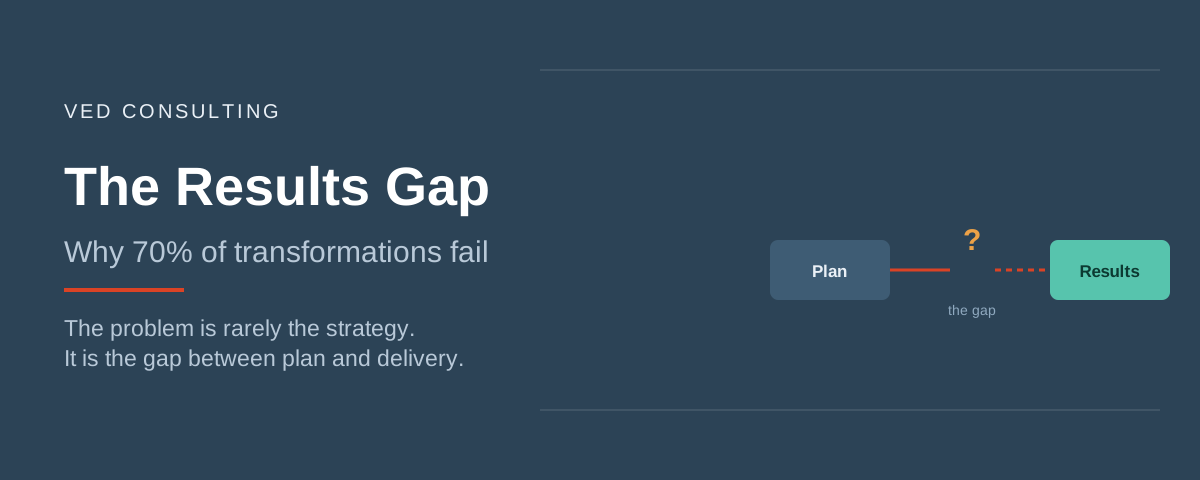
Few statistics in management are as durable, or as uncomfortable, as this one: roughly 70% of major organizational transformations fail to deliver their intended results. The figure has held remarkably steady across decades, industries, and consulting studies. What makes it striking is not the number itself but what it implies. If most transformations fail, and yet companies keep launching them with competent leaders and sound strategies, then the failure cannot be primarily about strategy. It is about the gap between deciding to change and actually changing — what we call the results gap. This article uses a simple structure — problem, analysis, solution — to examine why that gap opens, and how to close it.
The problem: a persistent gap between plan and result
The evidence points in one direction. Around 67% of well-formulated strategies fail because of poor execution, and about 70% of transformations break down at the execution stage rather than the strategy stage. Along the way, organizations lose close to 40% of a strategy’s potential value. The pattern is consistent: the thinking is usually adequate; the doing is where value leaks away.
Consider two familiar examples. A retailer commits to a digital transformation — new e-commerce platform, data analytics, omnichannel experience. The strategy is sound and the budget is approved. Two years later, adoption is patchy, the old and new systems run in parallel, and the promised growth has not materialized. Or a manufacturer implements a major ERP system to modernize operations. The software goes live, but people quietly keep their spreadsheets, workarounds proliferate, and the efficiency gains never appear. In neither case was the plan wrong. In both, the organization failed to convert the plan into changed behaviour. That is the results gap.
The analysis: why organizations fail
To close the gap, you have to understand its structure. The single most important insight is that planning and execution are different disciplines, governed by different logic. Planning is analytical, front-loaded, and largely intellectual — it happens in workshops and produces documents. Execution is behavioural, sustained, and organizational — it happens in thousands of daily choices made by people across the business, long after the launch event is over. Leaders who are excellent at planning routinely underestimate execution because it demands a completely different set of muscles: persistence over insight, coordination over analysis, and the management of human behaviour over the design of solutions.
Underneath that core distinction sit five recurring root causes.
No real ownership. Transformations are “launched” but not owned. A steering committee sponsors the change; no single accountable leader lives or dies by its results. Shared accountability becomes no accountability.
The plan is mistaken for progress. Organizations celebrate the strategy’s approval as if the work were done, when in fact it has barely begun. The energy peaks at launch — exactly when execution needs it most.
Change fatigue and insufficient buy-in. The people expected to change were not genuinely engaged in shaping it, so they comply on the surface and resist underneath. Culture quietly absorbs and neutralizes the initiative.
Misaligned incentives. The old metrics, targets, and rewards remain in place, so they keep pulling behaviour toward the old ways. People do what they are measured on, not what the transformation asks.
No feedback loop. There is no disciplined mechanism to track whether the change is actually happening on the ground, so problems surface too late to fix — usually as disappointing results, months after the moment to intervene has passed.
The solution: an execution framework
Closing the results gap requires treating execution as a discipline in its own right, resourced and governed as seriously as the strategy itself. A practical framework has five components — think of it as the engine that turns a plan into results.
Clarity. Translate the transformation from ambition into a small number of concrete, measurable outcomes that everyone can understand. If people cannot state what success looks like in a sentence, execution has no target.
Ownership. Assign a single accountable leader for each outcome — a name, not a committee — with the authority and the mandate to deliver it. Accountability must be individual to be real.
Capability. Ensure the people expected to change have the skills, tools, and capacity to do so. Transformation asks people to work differently; that is impossible if they have not been equipped and their existing workload has not been adjusted.
Cadence. Install a regular operating rhythm — a short, disciplined review where owners report progress against outcomes, obstacles are surfaced, and decisions are made. Execution is sustained by rhythm, not by launch events.
Adaptation. Build a genuine feedback loop that measures what is actually happening in the business, not just what was planned, and use it to course-correct quickly. Every successful transformation is adjusted repeatedly along the way.
Notice that four of these five components have nothing to do with the strategy itself. They are about the organizational plumbing that carries a decision through to a result — the plumbing most transformations never build.
Best practices that separate success from failure
Sequence for early wins. Deliver a visible, credible result early to build momentum and belief. Transformations that show nothing for a year lose the organization’s faith before they can prove themselves.
Realign incentives first, not last. Change what people are measured and rewarded on at the start, so the reward system pulls with the transformation rather than against it.
Engage the changers in the change. Involve the people who must adopt the new way in designing it. Buy-in is not a communication exercise after the fact; it is participation from the beginning.
Overinvest in the middle. Middle managers make or break execution — they are where strategy meets daily reality. Equip and enlist them explicitly rather than assuming they will comply.
Protect focus. Do not run ten transformations at once. Organizations have finite change capacity; spreading it thin guarantees that everything moves slowly and nothing lands.
Key takeaways
Most transformations fail at execution, not strategy — the plan is rarely the problem.
Planning and execution are different disciplines; excellence at one does not confer the other.
The recurring root causes are diffuse ownership, mistaking planning for progress, weak buy-in, misaligned incentives, and no feedback loop.
Closing the gap requires an execution engine: clarity, ownership, capability, cadence, and adaptation.
The payoff is large — organizations that execute well are markedly more likely to achieve above-average growth and profit.
Conclusion
The 70% failure rate is not a law of nature. It is the predictable result of treating transformation as a planning exercise when it is, overwhelmingly, an execution challenge. The organizations that beat the odds are not the ones with the cleverest strategies; they are the ones that build the discipline to carry a decision all the way through to a changed reality. Strategy earns the right to attempt a transformation. Execution is what determines whether it delivers. Close the results gap, and you move from the 70% that fail to the minority that actually change.
Posted by the Research Team at Ved Consulting. Ved Consulting helps leadership teams close the gap between strategy and results.