
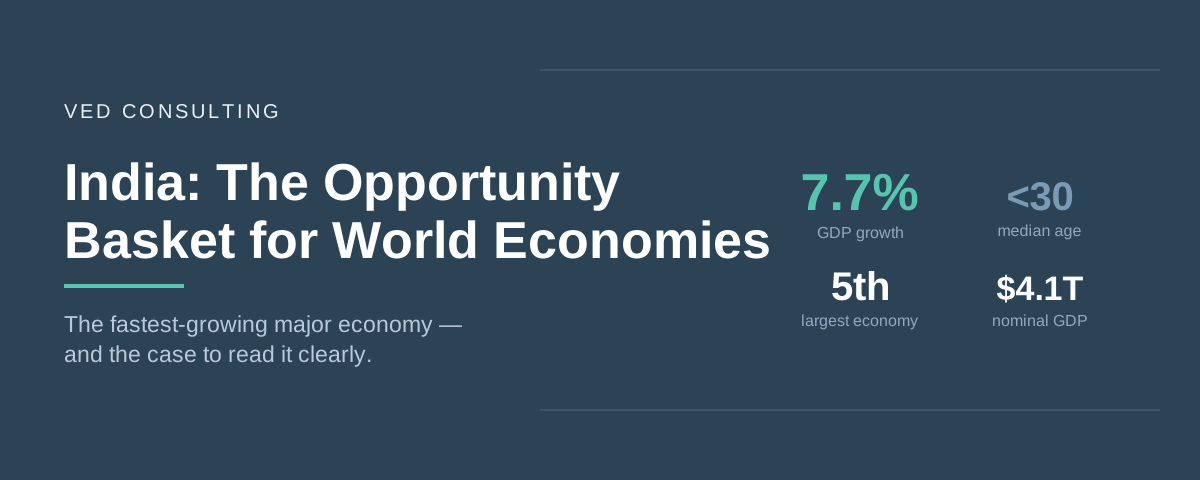
For a decade, “India’s moment” has been a phrase in search of proof. In 2026, the evidence is finally hard to argue with. India is the fastest-growing major economy in the world, expanding at roughly 7.7% in FY2025-26 while most large economies struggle to reach half that rate. It is the fifth-largest economy by nominal GDP, at about $4.15 trillion, and it is closing on the economies ahead of it. Yet the more useful question for global investors and Indian policymakers alike is not whether India is growing, but whether it can convert growth into broad-based, durable prosperity. This is an economist’s case for optimism — with the caveats an honest analysis requires.
The numbers behind the story
Start with the data, because the data is genuinely striking. India’s GDP growth of 7.7% in FY2025-26, with the final quarter clocking 7.8%, is being driven by a rare combination of strong domestic consumption and rising investment — a “double engine” that reduces dependence on any single source of demand. Foreign capital is voting accordingly: cumulative FDI inflows crossed $1.14 trillion between 2000 and late 2025, and equity FDI rose about 21.7% year-on-year in the first nine months of FY26, led by investment in software and technology.
What distinguishes this cycle from previous bursts of Indian optimism is its breadth. Growth is not resting on a single commodity boom or a one-off reform. It is supported by a large and deepening domestic market, a maturing digital economy, and a manufacturing push that is beginning to attract global supply chains. For the world’s economies — facing ageing populations and saturated home markets — India represents something increasingly scarce: a large market that is still growing.
The demographic dividend — and its condition
India’s single greatest asset is demographic. Its median age is under 30, and its working-age population will keep expanding until the 2050s — a profile that stands in sharp contrast to the ageing societies of China, Japan, and much of Europe. In an economy, a young and growing workforce is potential energy: it can power decades of consumption and production if it is employed productively.
That last clause is the entire game. A demographic dividend is a conditional promise, not a guarantee. India must create millions of quality jobs every year to absorb its young entrants into the workforce; if it does not, the dividend curdles into a liability of underemployment and frustrated expectations. This is the central economic challenge of the era — not generating growth, but generating jobs at the scale and quality the demography demands. Any balanced view of India’s opportunity has to hold both truths at once: the potential is extraordinary, and its realisation is not automatic.
Why the world is investing
Three structural pulls explain the surge of global interest. The first is supply-chain diversification — the “China-plus-one” strategy through which multinationals are hedging concentration risk by building capacity in India. The second is the sheer size of the domestic market, which allows global firms to grow by selling into India, not merely producing there. The third, and most underappreciated, is India’s Digital Public Infrastructure.
India has built, at national scale, a stack of public digital rails — identity, payments, and data-sharing — that few countries can match. Real-time payments through UPI, a unified goods-and-services tax, and account-aggregator frameworks have lowered the cost of reaching customers and extending credit, formalising an economy that was long dominated by cash and informality. For investors, this infrastructure reduces friction and widens the addressable market. It is a genuine, hard-to-replicate competitive advantage.
The honest constraints
A data-oriented assessment must give the constraints their due, because they are real and they are binding.
- Jobs. The economy is growing faster than formal employment. Converting output growth into mass, good-quality employment is the defining unsolved problem.
- Infrastructure and logistics. Despite heavy public investment, gaps in logistics, power reliability, and urban infrastructure still raise the cost of doing business.
- Regulatory complexity. Ease of doing business has improved, but compliance burden, contract enforcement, and policy unpredictability remain deterrents at the margin.
- Inequality and skilling. Growth has not been evenly shared, and a large share of the workforce lacks the skills that the fastest-growing sectors demand.
None of these negate the opportunity. But they determine its ceiling. The difference between India growing at 6% and at 8% over the next two decades — and the difference between growth that lifts the median household and growth that concentrates — will be decided largely by how these constraints are addressed.
What it means — for the world and for India
For global businesses, the strategic implication is that India can no longer be a peripheral bet made for optics. Its market size, growth rate, and digital infrastructure make it a core pillar of any serious long-term growth strategy. But the firms that succeed will be those that localise genuinely — adapting products, price points, and go-to-market models to Indian realities rather than importing playbooks built elsewhere. India rewards patient, adapted capital and punishes the assumption that scale abroad translates automatically at home.
For India itself, the imperative is to keep converting momentum into structure: to sustain investment, deepen skilling, ease the friction of doing business, and above all to make growth job-rich. The demographic window is open now and will not stay open forever. The economies that aged before they grew rich offer a cautionary lesson; India has the rarer chance to grow rich while it is still young — if it moves with purpose.
Conclusion: an opportunity to be earned
India is, on the evidence, the most compelling large-economy opportunity of this decade — a rare basket of scale, growth, demography, and digital capability that the rest of the world increasingly cannot ignore. But an opportunity basket is not a guaranteed harvest. The upside is real and large; so is the execution risk. The balanced conclusion is neither the breathless triumphalism nor the reflexive scepticism that so often frame the India story, but something more useful: a clear-eyed recognition that India’s potential is genuine, its constraints are addressable, and the outcome will be earned rather than given.
Posted by the Research Team at Ved Consulting.
Connect with us on LinkedIn: https://www.linkedin.com/company/vedconsulting/